Apresentamos o LDF: o formato de documento da próxima geração
Como estamos reinventando a criação de documentos para equipes modernas com um formato nativo da web que é 35% menor, infinitamente mais rápido e criado para fluxos de trabalho com IA em primeiro lugar.
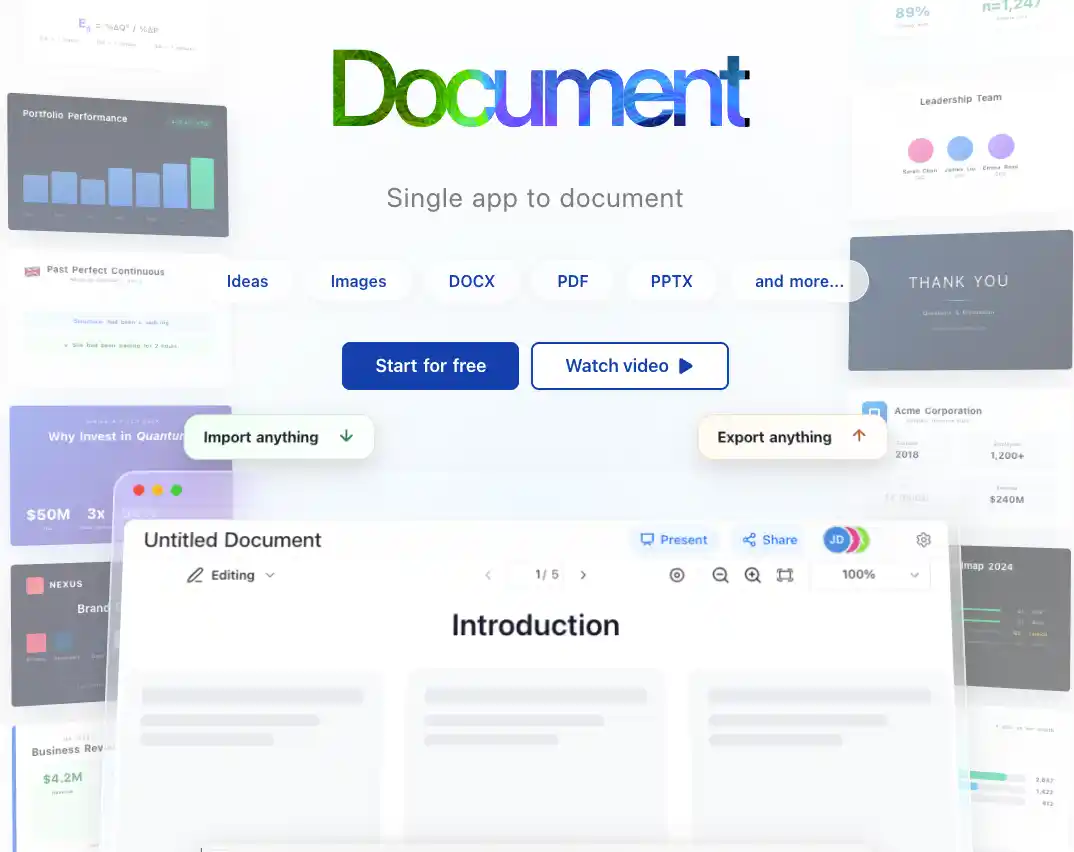
Traditional document formats were designed for a pre-cloud era. PDF, created in 1993, and Microsoft Office formats from the early 2000s weren't built for real-time collaboration, AI integration, or modern web performance standards. As organizations increasingly demand faster, more intelligent document workflows, these legacy formats have become critical bottlenecks.
Today, we're introducing LDF (Lean Document Format) and the Eddocu platform—a complete reimagining of document creation, editing, and collaboration for the modern web.
The Challenge with Legacy Formats
Our research across thousands of enterprise users revealed systemic inefficiencies in traditional document workflows:
- Limited editability: PDF editing fundamentally breaks document fidelity, requiring expensive specialized tools
- Format lock-in: Proprietary specifications limit interoperability and innovation
- AI integration gaps: Traditional formats lack structured metadata for effective AI processing
- Inefficient compression: File sizes 35-40% larger than necessary, increasing storage and bandwidth costs
- Cost barriers: Enterprise document solutions require significant licensing investments
- Performance bottlenecks: Legacy formats require downloading entire files before viewing, creating latency in distributed teams
These limitations compound at scale. For enterprise teams managing thousands of documents, the productivity loss and infrastructure costs become substantial.
Introducing LDF: Web-Native Document Architecture
LDF is a modern document format built from the ground up for web-native performance, AI-first workflows, and real-time collaboration. Rather than retrofitting cloud features onto desktop-era specifications, we designed LDF specifically for how teams work today.
LDF represents a fundamental shift: documents become intelligent, living artifacts rather than static files. Help you design documents with consistent design systems, and commonalized tokens.
Intelligent Import with Automatic Design System Extraction
Eddocu's import engine analyzes PDF, PPTX, and DOCX files to automatically extract design tokens—typography scales, color palettes, spacing systems, and component patterns. This creates a consistent design language across your entire document library without manual standardization.
For organizations migrating large document repositories, this automation reduces standardization time from weeks to minutes while maintaining brand consistency.
Performance Architecture
LDF's streaming architecture delivers measurable performance improvements:
- 35% smaller file sizes compared to PPTX/DOCX at equivalent compression levels
- 20% reduction versus PDF through modern compression algorithms
- Progressive loading: Fetch only requested pages, reducing initial payload by up to 90% for large documents
- Sub-second rendering on mobile devices, even for complex presentations
These optimizations translate directly to cost savings: reduced CDN egress, faster page loads, and improved user experience across global teams.
High-Performance Web Editor
Eddocu, right now is the world's most performant web based document/pdf/presentation editor on some benchmarks.
Native AI Integration
Eddocu, is an AI native format.
- Smart selection you can select specific contexts, images, text areas and have conversation with AIs.
- Specialized AI Chat
- AI Assisted Document Generation, there's an ongoing development here. While Eddocu is not the most advanced Slide generation tool yet, it's getting better.
- Yet to come..
Enterprise Deployment
Eddocu is designed for enterprise adoption with security, compliance, and scalability as core requirements:
- Ongoing progres here..
This foundation enables new collaborative workflows: live presentation co-editing, asynchronous review cycles, and distributed team coordination—all within the document itself.
Looking Forward
For decades, document editing has been constrained by proprietary formats and expensive licensing barriers. Organizations have been forced to choose between incompatible ecosystems—each with its own format specifications, vendor lock-in, and substantial costs. This fragmentation has stifled innovation and created unnecessary friction in how teams create and share information.
Our roadmap includes expanded AI capabilities, advanced analytics for document usage patterns, and deeper integrations with enterprise content management systems. Beyond product development, we're committed to democratizing access to modern document technology.
Commitment to Open Source
Eddocu plans to contribute core components of the LDF specification and reference implementations to the open source community. By opening the format specification, we aim to enable ecosystem-wide innovation—allowing developers worldwide to build tools, converters, and integrations without proprietary barriers.
Our vision is a future where document formats are collaborative standards rather than competitive moats. Open sourcing portions of LDF will enable academic research, accelerate format adoption, and ensure long-term interoperability across platforms and tools.
LDF isn't an incremental improvement—it's a fundamental rethinking of what a document is.
Ready to experience the future of document creation? Start importing your existing PDF, PPTX, and DOCX files today and discover how LDF transforms your document workflows.